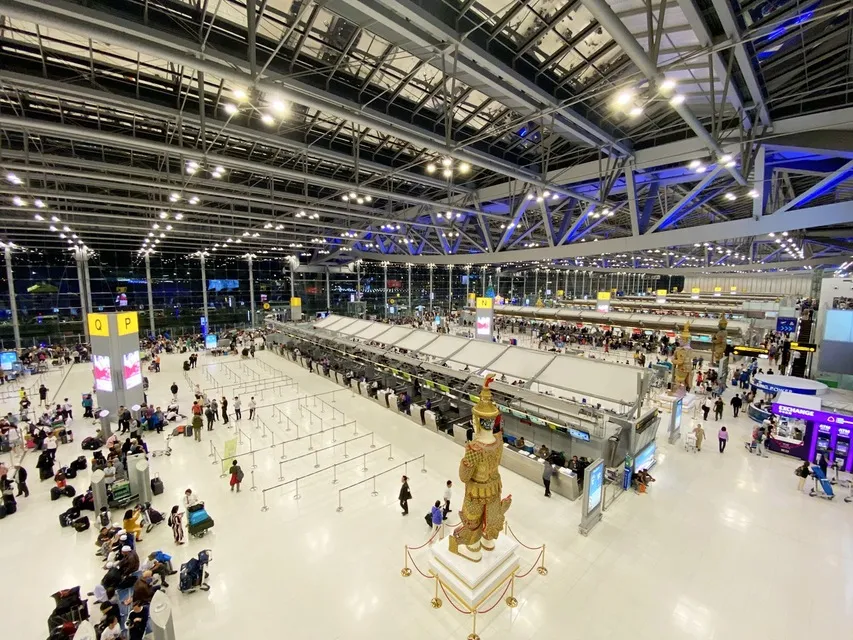
The check-in hall at Suvarnabhumi Airport (BKK), Samut Prakan Photo above: Wisit W. via Google
No, US citizens do not need a visa for a tourist trip to Thailand of up to 30 days. Since September 15, 2026, holders of a US passport can enter Thailand visa-free for tourism for up to 30 days, according to Thailand's Ministry of Foreign Affairs and the Royal Thai Embassy in Washington, D.C. (checked September 26, 2026). The stay can be extended once, by up to 30 more days, at the immigration officer's discretion. If you plan to stay longer from the start, or you are traveling to work, study or retire, apply for a visa before you leave through Thailand's official e-Visa website, thaievisa.go.th.
This guide explains the Thailand visa rules for US citizens as they stand in September 2026: the 30-day visa exemption, what to carry, the Thailand Digital Arrival Card, extensions, and how the e-Visa works for Americans. Every rule below is taken from an official Thai government page and dated. Entry rules change, and they changed this month, so confirm on the official pages before you book.
Do US citizens need a visa for Thailand in 2026?
US citizens do not need a visa for tourism stays of up to 30 days. Thailand's revised visa exemption scheme took effect on September 15, 2026, and the United States is on its list of 60 countries and territories whose passport holders may stay up to 30 days for tourism. The Royal Thai Embassy in Washington, D.C. updated its visa page on September 17, 2026 to say the same.
The new 30-day rule replaced the 60-day visa exemption that applied before September 15, 2026. The Tourism Authority of Thailand (TAT) said on September 1, 2026 that the 60-day measure would end on that date, and that the Ministry of Interior announcements were published in the Royal Gazette on August 31, 2026. Articles and forum posts that still quote 60 days for Americans are out of date.
| Question | Answer for US passport holders (as of September 26, 2026) | Official source |
|---|---|---|
| Visa needed for tourism? | No, for stays up to 30 days | Ministry of Foreign Affairs; Royal Thai Embassy, Washington |
| Can it be extended? | Once, by up to 30 days, at the immigration officer's discretion | Royal Thai Embassy, Washington |
| Cash to carry | 20,000 baht per person or 40,000 baht per family, or the equivalent | Royal Thai Embassy, Washington |
| Arrival card | Thailand Digital Arrival Card (TDAC), within 3 days before arrival | Immigration Bureau; Royal Thai Embassy, Washington |
| Visa on arrival? | Not applicable; the 2026 visa-on-arrival list covers only Azerbaijan, Belarus and Serbia | Ministry of Foreign Affairs |
| Entries by land | Generally no more than twice per calendar year under the 30-day exemption | TAT, citing the Royal Gazette |
How long can Americans stay in Thailand without a visa?
Americans can stay in Thailand for up to 30 days without a visa when the purpose of the trip is tourism. The Royal Thai Embassy in Washington says the stay can be extended for another period not exceeding 30 days, and that the extension is solely at the discretion of the immigration officer. You apply for it in Thailand, at an office of the Immigration Bureau.
Count the days carefully. The permitted stay is set by the immigration officer and stamped in your passport when you arrive, so check the stamp before you leave the counter. For how the count works, extensions and what happens if you overstay, read our guide to how long you can stay in Bangkok, and for applying in person, where the immigration office in Bangkok is.
What do US citizens need to enter Thailand visa-free?
To enter Thailand under the 30-day visa exemption, a US citizen needs a US passport, a completed Thailand Digital Arrival Card, and enough funds. The Royal Thai Embassy in Washington says travelers entering under the tourist visa exemption scheme must have cash of 20,000 baht per person or 40,000 baht per family, or the equivalent (checked September 26, 2026).
- Passport: the exemption applies only to passports issued by a listed country, not to other travel documents. The embassy says temporary or emergency passports are accepted by the Immigration Bureau if they are valid for at least six months. Thailand's e-Visa website warns that a passport valid for less than six months may lead to a visa being refused, so six months' validity is the safe standard for any trip.
- TDAC: the Thailand Digital Arrival Card is required for all non-Thai travelers, including those entering under the visa exemption.
- Funds: 20,000 baht per person or 40,000 baht per family, or the equivalent, per the embassy.
- Purpose: the exemption is for tourism. Business, work, study and long stays need the right visa.
The official pages we checked do not list an onward or return ticket as a written requirement, but airlines and immigration officers can ask how and when you are leaving, so keep your booking to hand.
Do Americans need the Thailand Digital Arrival Card?
Yes. Since May 1, 2025, all non-Thai nationals entering Thailand by air, land or sea must complete the Thailand Digital Arrival Card (TDAC) online within 3 days before arrival, the Royal Thai Embassy in Washington says. The embassy stresses that the TDAC is not a visa: it is an immigration requirement for every traveler, including those using the visa exemption.
Use only the official site, tdac.immigration.go.th, where the card is free. Our step-by-step Thailand Digital Arrival Card guide covers what the form asks, how to fix mistakes and how to avoid fee-charging look-alike sites.

When do US citizens need a visa for Thailand?
US citizens need a visa if they plan to stay longer than the visa exemption allows, or if the trip is not tourism, for example work, business, study, retirement or joining family. The Royal Thai Embassy in Washington says the type of visa depends on the purpose of the visit, and that all visa applications from the United States go through Thailand's e-Visa portal, thaievisa.go.th.
The e-Visa portal groups visas into categories that include tourist visas, transit visas, the Destination Thailand Visa (DTV) and long-term visas. The Washington embassy posted a new DTV requirement effective August 31, 2026; read its visa page for the details before you apply. We have not listed visa fees here because the embassy publishes them by visa type and they can change; check the Visa Types, Fees and Validity page for the current figure.
How do Americans apply for a Thai e-Visa?
Americans apply for a Thai visa online at thaievisa.go.th, the only channel the Royal Thai Embassy and consulates in the United States use for visas. The embassy says applicants no longer mail passports or documents, and it does not accept walk-in or drop-off visa applications. An approved visa arrives by email, and the embassy asks travelers to print the confirmation to show the airline and Thai immigration.
- Check that you need a visa. For tourism under 30 days, a US passport holder does not.
- Create an account on thaievisa.go.th. One account can hold applications for family members or travel companions, but each traveler needs a separate application.
- Choose the embassy or consulate for your state (see the table below).
- Enter your details exactly as in your passport. The embassy says the officers cannot edit an application, so a mistake means reapplying and paying again.
- Upload documents and pay the fee by credit card in the e-Visa system. The embassy recommends Visa or Mastercard and says the fee is non-refundable.
- Wait for the decision by email, and check your spam folder for requests for more documents.
Timing: the embassy advises applying at least 30 days before departure, but not more than 90 days ahead, because most visas are valid for about 90 days from issue. The e-Visa site also says you cannot apply while you are physically in Thailand.
| Apply through | For residents of |
|---|---|
| Royal Thai Embassy, Washington, D.C. | Alabama, Delaware, District of Columbia, Florida, Georgia, Louisiana, Maryland, Mississippi, North Carolina, South Carolina, Tennessee, Texas, Virginia, West Virginia, Puerto Rico |
| Royal Thai Consulate-General, Los Angeles | Alaska, Arizona, California, Colorado, Hawaii, Idaho, Montana, Nevada, New Mexico, Oregon, Utah, Washington, Wyoming and the US Pacific territories such as Guam |
| Royal Thai Consulate-General, New York | Connecticut, Maine, Massachusetts, New Hampshire, New Jersey, New York, Ohio, Pennsylvania, Rhode Island, Vermont |
| Royal Thai Consulate-General, Chicago | Arkansas, Illinois, Indiana, Iowa, Kansas, Kentucky, Michigan, Minnesota, Missouri, Nebraska, North Dakota, Oklahoma, South Dakota, Wisconsin |
Source: Royal Thai Embassy, Washington, D.C., jurisdiction list, checked September 26, 2026.
What is the difference between visa validity and length of stay?
A Thai visa's validity is the window in which you must use it to enter Thailand; the length of stay is how long you may remain after entering. The Royal Thai Embassy in Washington explains that the permitted stay is decided by the immigration officer at the port of entry and shown by the stamp in your passport. Extensions of stay are handled by the Immigration Bureau in Thailand, not by the embassy.
Can US citizens cross into Thailand by land on the visa exemption?
Yes, but with a limit. TAT, citing the Royal Gazette, says travelers using the 30-day visa exemption may generally enter through land-border checkpoints no more than twice per calendar year; the exceptions listed are for nationals of Malaysia, Brunei, Indonesia and Singapore, so the limit applies to Americans. Arriving by air is not affected by this limit.
Which rules could not be confirmed?
We could not open the Immigration Bureau's own website when we checked on September 26, 2026, so details that only the Immigration Bureau sets, such as the fee and paperwork for a 30-day extension and any limit on repeat visa-exempt entries by air, are not given here. Check the Immigration Bureau, or the Royal Thai Embassy in Washington, before you rely on them. For staying longer than 90 days, the embassy links an Immigration Bureau notice on reporting your address every 90 days.
Once your entry is sorted, plan the rest of the trip: our Bangkok travel tips for first-time visitors cover money, transport and etiquette, and our guide to where to stay in Bangkok helps you choose a neighborhood. You can also browse Bangkok hotels, which you will need for the accommodation address on your TDAC.
Sources: Department of Consular Affairs, Ministry of Foreign Affairs, summary of the 2026 visa exemption and visa on arrival schemes (effective September 15, 2026), Royal Thai Embassy, Washington, D.C., new visa exemption, Royal Thai Embassy, Washington, D.C., visa information, Royal Thai Embassy, Washington, D.C., visa FAQs, Royal Thai Embassy, Washington, D.C., visa types, fees and validity, Tourism Authority of Thailand, new visa exemption rules, Thailand e-Visa, Immigration Bureau, Thailand Digital Arrival Card. Checked September 26, 2026.
Not for tourism of up to 30 days. From September 15, 2026, US passport holders can enter visa-free for tourism for up to 30 days, per Thailand's Ministry of Foreign Affairs and the Royal Thai Embassy in Washington (checked September 26, 2026).
No. The 60-day visa exemption ended on September 15, 2026, when the new 30-day scheme took effect, according to TAT and the Ministry of Foreign Affairs.
Yes, once, by up to 30 days, at the discretion of the immigration officer, according to the Royal Thai Embassy in Washington. Apply at an Immigration Bureau office in Thailand before your stay ends.
The Royal Thai Embassy in Washington says travelers under the tourist visa exemption must have 20,000 baht per person or 40,000 baht per family, or the equivalent (checked September 26, 2026).
No, and they do not need one for tourism. Under the 2026 scheme, visa on arrival applies only to passport holders from Azerbaijan, Belarus and Serbia.
Online at thaievisa.go.th. The Royal Thai Embassy and consulates in the US no longer accept mailed or walk-in visa applications, and the approved visa is sent by email.
The Royal Thai Embassy in Washington suggests at least 30 days before departure, but not more than 90 days ahead, because most visas are valid for about 90 days from issue.
Yes. Every non-Thai traveler, including visa-exempt Americans, must submit the Thailand Digital Arrival Card online within 3 days before arrival, on the free official site tdac.immigration.go.th.