Erawan Shrine
About
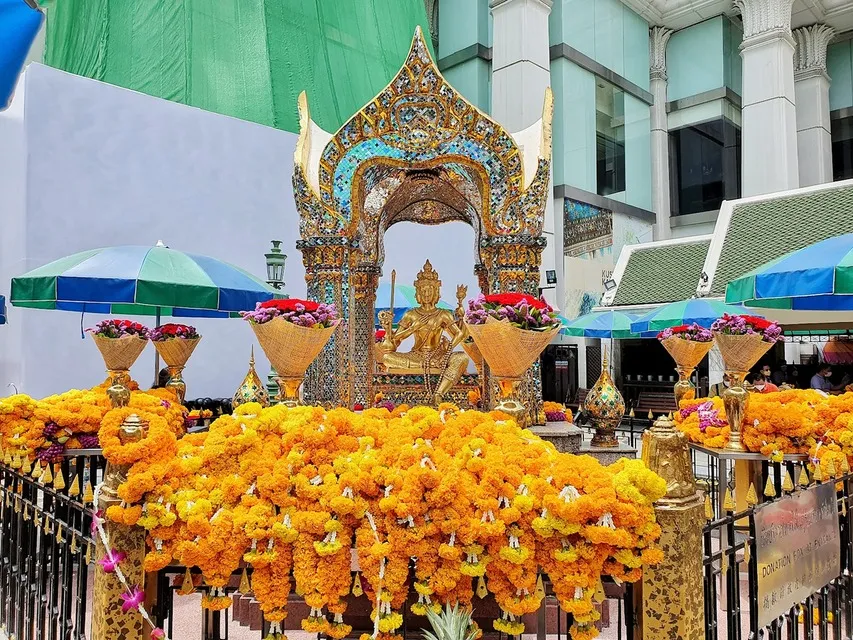
The Erawan Shrine, officially the Thao Maha Phrom Shrine, is an open-air shrine to the four-faced Brahma on the corner of the Ratchaprasong intersection, in front of the Grand Hyatt Erawan Bangkok. It was set up in 1956, while the original Erawan Hotel was being built, after advisers in Thai astrology recommended a guardian shrine for the site. The Brahma image was designed and crafted by Thailand's Fine Arts Department and enshrined on 9 November 1956.
It is a place of active worship before it is a sight, open from early morning to late evening to Thai devotees and to worshippers from China, Hong Kong, Singapore, Taiwan and beyond, and it is worth a respectful stop during a day around the Ratchaprasong and Chit Lom shopping district. Entry is free, and the shrine is reached on foot from BTS Chit Lom by the elevated skywalk.
What you will see
Devotees bring incense, candles and garlands, either their own or sets bought from vendors around the shrine, and move from face to face around the image. Carved wooden elephants are left as offerings, and traditional Thai dancers perform for worshippers who come back to give thanks when a prayer has been answered. The shrine's own account describes the practice as a blend of Hinduism, Buddhism and Thai folk belief, with Thao Maha Phrom revered as a guardian figure.
Paying respects
Worship starts at the front-facing image and moves clockwise until all four faces have been honored, with the same offering at each and a final bow at the end. Tradition holds that the four faces spread compassion and protection in every direction, so devotees pray for work, relationships, health and safety alike. Many devotees also recite the Brahma chant, repeating it three or nine times.
Etiquette
Dress modestly, speak softly and keep out of the way of people who are praying. Because the shrine is outdoors, shoes stay on. Rules on lighting incense and candles can change, so follow the notices and staff on the day.
Sources: Erawan Shrine, history, how to worship, visitor information. Checked September 25, 2026.
Contact Information
Bangkok, 10330
Photo: Kok Seng Ng (Paschen) via Google
Erawan Shrine
About Erawan Shrine
The Erawan Shrine, officially the Thao Maha Phrom Shrine, is an open-air shrine to the four-faced Brahma on the corner of the Ratchaprasong intersection, in front of the Grand Hyatt Erawan Bangkok. It was set up in 1956, while the original Erawan Hotel was being built, after advisers in Thai astrology recommended a guardian shrine for the site. The Brahma image was designed and crafted by Thailand's Fine Arts Department and enshrined on 9 November 1956.
It is a place of active worship before it is a sight, open from early morning to late evening to Thai devotees and to worshippers from China, Hong Kong, Singapore, Taiwan and beyond, and it is worth a respectful stop during a day around the Ratchaprasong and Chit Lom shopping district. Entry is free, and the shrine is reached on foot from BTS Chit Lom by the elevated skywalk.
What you will see
Devotees bring incense, candles and garlands, either their own or sets bought from vendors around the shrine, and move from face to face around the image. Carved wooden elephants are left as offerings, and traditional Thai dancers perform for worshippers who come back to give thanks when a prayer has been answered. The shrine's own account describes the practice as a blend of Hinduism, Buddhism and Thai folk belief, with Thao Maha Phrom revered as a guardian figure.
Paying respects
Worship starts at the front-facing image and moves clockwise until all four faces have been honored, with the same offering at each and a final bow at the end. Tradition holds that the four faces spread compassion and protection in every direction, so devotees pray for work, relationships, health and safety alike. Many devotees also recite the Brahma chant, repeating it three or nine times.
Etiquette
Dress modestly, speak softly and keep out of the way of people who are praying. Because the shrine is outdoors, shoes stay on. Rules on lighting incense and candles can change, so follow the notices and staff on the day.
Sources: Erawan Shrine, history, how to worship, visitor information. Checked September 25, 2026.