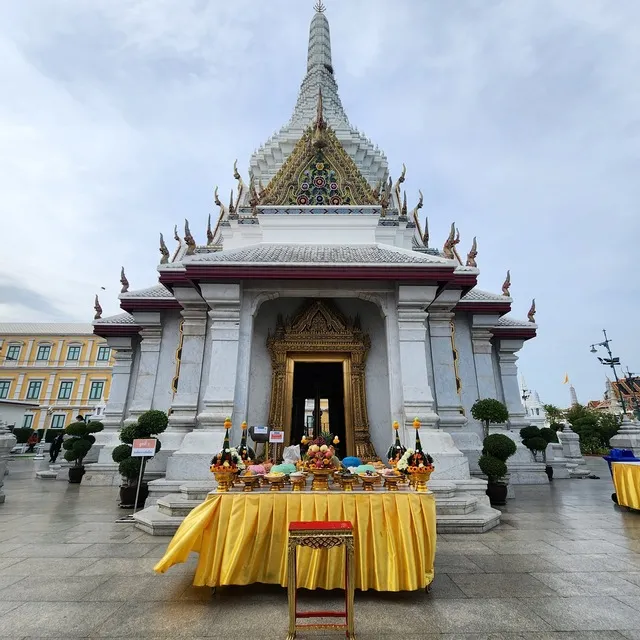
Bangkok City Pillar Shrine
About
The Bangkok City Pillar Shrine, San Lak Mueang, keeps the pillar raised at the founding of the capital. Following the Brahmin custom of raising a city pillar before a city is built, King Rama I had it set up on 21 April 1782 at the center of the new capital, Krung Rattanakosin, and the shrine has been a place of worship ever since.
It suits visitors who want to see a working shrine at the heart of Rattanakosin, where worshippers follow a set sequence of offerings, and it fits easily around a visit to the Grand Palace. The Tourism Authority of Thailand places it near Wat Phra Kaew, the Temple of the Emerald Buddha.
Two pillars
The first pillar, from Rama I's reign, is Javanese cassia wood with a sandalwood exterior and a tall, lotus-shaped top. As it aged, King Rama IV had a new pillar made, with a teak core, a cassia exterior and a rounder crown-shaped top. For the capital's 200th anniversary in 1982, King Bhumibol had the shrine renovated and the old pillar enshrined with the new one, and he attended the celebration of the restored shrine on 24 July 1986.
The five guardian deities
The restoration also added the Buddha Image Hall and a shrine for five guardian deities: Phra Suea Mueang, Phra Song Mueang, Phra Kanchaisi, Chao Chettakup and Chao Ho Klong, who are believed to protect the country from enemies and disasters. The shrine lies within Ministry of Defence grounds and has been looked after since 1948 by the War Veterans Organization of Thailand. The Fine Arts Department registered it as a historical site in 1975.
How to pay respect
The shrine describes five steps: offer a lotus in the Buddha Image Hall; light a candle and incense at the replica pillar, tie on three pieces of silk and apply gold leaf; offer a garland at the City Pillar; offer garlands to the five guardian deities; and finish by adding oil to the lamps of the Birthday Buddha images. Traditional Thai dance is performed at the shrine by those fulfilling vows.
Sources: Bangkok City Pillar Shrine, shrine history, how to pay respect, Tourism Authority of Thailand (archived), Grand Palace practical information. Checked September 26, 2026.
Contact Information
Bangkok, 10200
Photo: Prince Wongaroon via Google
Bangkok City Pillar Shrine
About Bangkok City Pillar Shrine
The Bangkok City Pillar Shrine, San Lak Mueang, keeps the pillar raised at the founding of the capital. Following the Brahmin custom of raising a city pillar before a city is built, King Rama I had it set up on 21 April 1782 at the center of the new capital, Krung Rattanakosin, and the shrine has been a place of worship ever since.
It suits visitors who want to see a working shrine at the heart of Rattanakosin, where worshippers follow a set sequence of offerings, and it fits easily around a visit to the Grand Palace. The Tourism Authority of Thailand places it near Wat Phra Kaew, the Temple of the Emerald Buddha.
Two pillars
The first pillar, from Rama I's reign, is Javanese cassia wood with a sandalwood exterior and a tall, lotus-shaped top. As it aged, King Rama IV had a new pillar made, with a teak core, a cassia exterior and a rounder crown-shaped top. For the capital's 200th anniversary in 1982, King Bhumibol had the shrine renovated and the old pillar enshrined with the new one, and he attended the celebration of the restored shrine on 24 July 1986.
The five guardian deities
The restoration also added the Buddha Image Hall and a shrine for five guardian deities: Phra Suea Mueang, Phra Song Mueang, Phra Kanchaisi, Chao Chettakup and Chao Ho Klong, who are believed to protect the country from enemies and disasters. The shrine lies within Ministry of Defence grounds and has been looked after since 1948 by the War Veterans Organization of Thailand. The Fine Arts Department registered it as a historical site in 1975.
How to pay respect
The shrine describes five steps: offer a lotus in the Buddha Image Hall; light a candle and incense at the replica pillar, tie on three pieces of silk and apply gold leaf; offer a garland at the City Pillar; offer garlands to the five guardian deities; and finish by adding oil to the lamps of the Birthday Buddha images. Traditional Thai dance is performed at the shrine by those fulfilling vows.
Sources: Bangkok City Pillar Shrine, shrine history, how to pay respect, Tourism Authority of Thailand (archived), Grand Palace practical information. Checked September 26, 2026.
Frequently Asked Questions
Things to do in Bangkok
BangkokVacay may earn a commission from Klook bookings made through this box, at no extra cost to you.