The Grand Palace
About
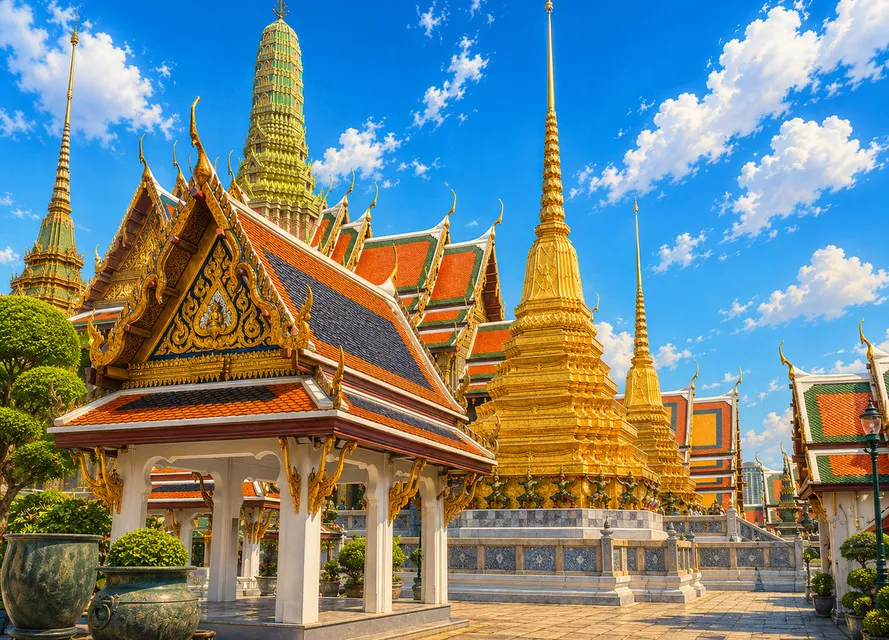
The Grand Palace has been the official residence of the Kings of Siam, and later Thailand, since 1782, when King Rama I moved the capital to the east bank of the Chao Phraya and built a palace that was also the seat of government. Its crenellated walls enclose some 218,000 square meters of throne halls, residences, former offices and the Temple of the Emerald Buddha, Wat Phra Kaew, which serves as the Chapel Royal.
On a first trip to Bangkok it anchors a day in the old city, and that day should start early: ticket sales end in mid-afternoon. The palace stands in the old royal quarter of Rattanakosin, where rail stations are few and the river does most of the work, and its temple neighbor Wat Pho lies just to the south, with Wat Arun across the water.
Wat Phra Kaew, the Chapel Royal
The temple fills the northeast of the Front Court behind a cloister wall. It has every building of a Buddhist monastery except living quarters, because monks do not reside here. King Rama I installed the Emerald Buddha in the Phra Ubosot, the convocation hall, and named the temple Wat Phra Sri Rattanasasadaram. Twelve marble-based pavilions flank the hall, where the faithful sit for sermons and chanting on Buddhist holy days. The Emerald Buddha is dressed in one of three costumes, changed for the hot, rainy and cool seasons, so what you see depends on when you visit.
Beyond the temple
The ticket also covers the Queen Sirikit Museum of Textiles in the Ratsadakorn-bhibhathana Building, which Queen Sirikit asked to turn into a textile museum in 2003; photography is not allowed in its galleries. For a break, the Doi Kham shop near the Srisuntara Gate and the Dusit Maha Prasat Throne Hall sells drinks, snacks and products from royal projects inside the Attavijana Sala, a Rama I-era brick building that once served as a court.
Before you go
The palace is a place of reverence for Thai people and publishes a strict dress code, checked at the gate, so plan clothes that cover shoulders and legs before you leave the hotel. Parts of the compound can close for royal ceremonies, and the palace posts a daily schedule online.
Getting there
The palace's own directions favor the river: the orange-flag Chao Phraya Express Boat from Sathorn Pier, below BTS Saphan Taksin, stops at Tha Chang beside the palace. MRT Sanam Chai is the nearest rail station, and tuk-tuk fares are best agreed before you set off.
Sources: The Grand Palace, history, practical information, visitor FAQ, facilities, Queen Sirikit Museum of Textiles. Checked September 25, 2026.
Contact Information
Bangkok, 10200
Photo: Eric Ho via Google
The Grand Palace
About The Grand Palace
The Grand Palace has been the official residence of the Kings of Siam, and later Thailand, since 1782, when King Rama I moved the capital to the east bank of the Chao Phraya and built a palace that was also the seat of government. Its crenellated walls enclose some 218,000 square meters of throne halls, residences, former offices and the Temple of the Emerald Buddha, Wat Phra Kaew, which serves as the Chapel Royal.
On a first trip to Bangkok it anchors a day in the old city, and that day should start early: ticket sales end in mid-afternoon. The palace stands in the old royal quarter of Rattanakosin, where rail stations are few and the river does most of the work, and its temple neighbor Wat Pho lies just to the south, with Wat Arun across the water.
Wat Phra Kaew, the Chapel Royal
The temple fills the northeast of the Front Court behind a cloister wall. It has every building of a Buddhist monastery except living quarters, because monks do not reside here. King Rama I installed the Emerald Buddha in the Phra Ubosot, the convocation hall, and named the temple Wat Phra Sri Rattanasasadaram. Twelve marble-based pavilions flank the hall, where the faithful sit for sermons and chanting on Buddhist holy days. The Emerald Buddha is dressed in one of three costumes, changed for the hot, rainy and cool seasons, so what you see depends on when you visit.
Beyond the temple
The ticket also covers the Queen Sirikit Museum of Textiles in the Ratsadakorn-bhibhathana Building, which Queen Sirikit asked to turn into a textile museum in 2003; photography is not allowed in its galleries. For a break, the Doi Kham shop near the Srisuntara Gate and the Dusit Maha Prasat Throne Hall sells drinks, snacks and products from royal projects inside the Attavijana Sala, a Rama I-era brick building that once served as a court.
Before you go
The palace is a place of reverence for Thai people and publishes a strict dress code, checked at the gate, so plan clothes that cover shoulders and legs before you leave the hotel. Parts of the compound can close for royal ceremonies, and the palace posts a daily schedule online.
Getting there
The palace's own directions favor the river: the orange-flag Chao Phraya Express Boat from Sathorn Pier, below BTS Saphan Taksin, stops at Tha Chang beside the palace. MRT Sanam Chai is the nearest rail station, and tuk-tuk fares are best agreed before you set off.
Sources: The Grand Palace, history, practical information, visitor FAQ, facilities, Queen Sirikit Museum of Textiles. Checked September 25, 2026.