Wat Arun
About
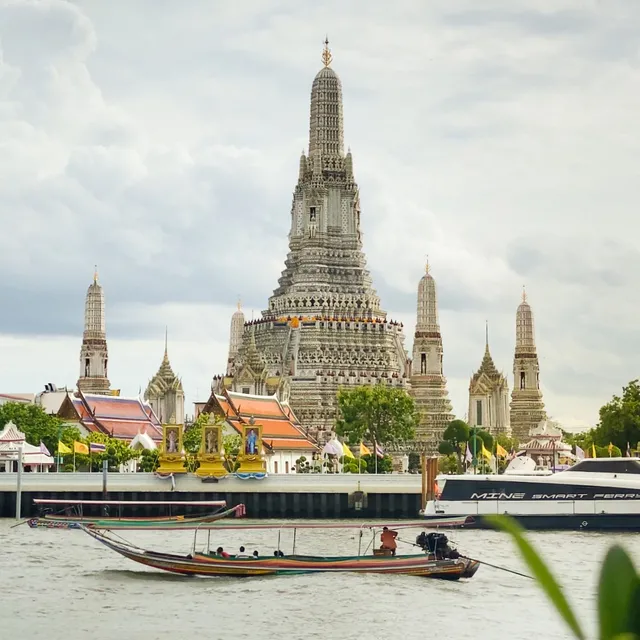
Wat Arun, the Temple of Dawn, officially Wat Arun Ratchawararam Ratchaworamahawihan, rises from the west bank of the Chao Phraya in Bangkok Yai, on the Thonburi side of the river. Its central prang stands 66.8 meters high and is covered in seashells and pieces of Chinese porcelain that catch the sun, and it is lit every night from sunset to sunrise. The Tourism Authority of Thailand uses the temple in its logo.
It is the natural third stop on an old-city day with the Grand Palace and Wat Pho, which face it from the opposite bank, It rewards two looks if you can manage it: the porcelain detail up close in daylight, and the lit prang from the river after dark. Getting there is a boat ride rather than a taxi.
The prang
The tall central tower is the reason to come. Up close, its surface turns out to be set with pieces of porcelain and shells, which is why it glimmers in strong sun. The Fine Arts Department finished a three-year renovation to secure the prang's base in 2017. Wat Pho tells a legend of the stone giant who guards Wat Arun, which it calls Wat Jaeng: a quarrel with the giant of Wat Pho across the river flattened the bank at Tha Tien, the landing you use to cross between the two temples today.
After dark
In 2024 the Japan-based YAKEI Convention and Visitors Bureau certified Wat Arun as a World Night View Heritage site for the view of the illuminated prang over the river. The temple is lit from 6 p.m. to 6 a.m., so an evening on the river or on the opposite bank is the time to see it.
Getting there
The Chao Phraya Express Boat stops at Wat Arun Pier, and a cross-river ferry links the temple with Tha Tien Pier beside Wat Pho. The temple can also be entered from Mae Phueak Pier and from Wang Doem Road on the land side.
Sources: Wat Arun (official Facebook page), Tourism Authority of Thailand, 2020, Tourism Authority of Thailand, 2024, Wat Pho directions, Wat Pho, Legend of Yak Wat Pho. Checked September 25, 2026.
Contact Information
Bangkok, 10600
Photo: Manit Monsur via Google
Wat Arun
About Wat Arun
Wat Arun, the Temple of Dawn, officially Wat Arun Ratchawararam Ratchaworamahawihan, rises from the west bank of the Chao Phraya in Bangkok Yai, on the Thonburi side of the river. Its central prang stands 66.8 meters high and is covered in seashells and pieces of Chinese porcelain that catch the sun, and it is lit every night from sunset to sunrise. The Tourism Authority of Thailand uses the temple in its logo.
It is the natural third stop on an old-city day with the Grand Palace and Wat Pho, which face it from the opposite bank, It rewards two looks if you can manage it: the porcelain detail up close in daylight, and the lit prang from the river after dark. Getting there is a boat ride rather than a taxi.
The prang
The tall central tower is the reason to come. Up close, its surface turns out to be set with pieces of porcelain and shells, which is why it glimmers in strong sun. The Fine Arts Department finished a three-year renovation to secure the prang's base in 2017. Wat Pho tells a legend of the stone giant who guards Wat Arun, which it calls Wat Jaeng: a quarrel with the giant of Wat Pho across the river flattened the bank at Tha Tien, the landing you use to cross between the two temples today.
After dark
In 2024 the Japan-based YAKEI Convention and Visitors Bureau certified Wat Arun as a World Night View Heritage site for the view of the illuminated prang over the river. The temple is lit from 6 p.m. to 6 a.m., so an evening on the river or on the opposite bank is the time to see it.
Getting there
The Chao Phraya Express Boat stops at Wat Arun Pier, and a cross-river ferry links the temple with Tha Tien Pier beside Wat Pho. The temple can also be entered from Mae Phueak Pier and from Wang Doem Road on the land side.
Sources: Wat Arun (official Facebook page), Tourism Authority of Thailand, 2020, Tourism Authority of Thailand, 2024, Wat Pho directions, Wat Pho, Legend of Yak Wat Pho. Checked September 25, 2026.