Wat Pho
About
Wat Pho, officially Wat Phra Chetuphon Wimon Mangkhalaram Rajwaramahawihan, is a first-grade royal monastery immediately south of the Grand Palace, and it is where most visitors meet Bangkok's Reclining Buddha: a gilded brick-and-stucco figure 46 meters long, its feet inlaid with mother-of-pearl. King Rama I rebuilt an older Ayutthaya-era temple here from 1788, and King Rama III's great restoration set out to make it a center of Thai arts and learning.
It pairs naturally with the Grand Palace on a first day in the old city, and it stays open well into the evening, later than its neighbor, which makes it a good second stop. Visitors who want time among the chedis and cloisters rather than a quick look at the Reclining Buddha, and anyone curious about Thai massage, will get the most from it. A ferry from Tha Tien pier crosses the river to Wat Arun.
The Reclining Buddha
The image lies in its own hall in the northwest of the temple, 15 meters high from the base to the topknot. The soles of the feet are the detail to find: mother-of-pearl panels showing the 108 auspicious symbols of the Buddha's footprint. The hall's murals, from the reign of King Rama III, tell stories of the Buddha's foremost disciples and of Buddhism in Sri Lanka.
Four royal chedis and the ordination hall
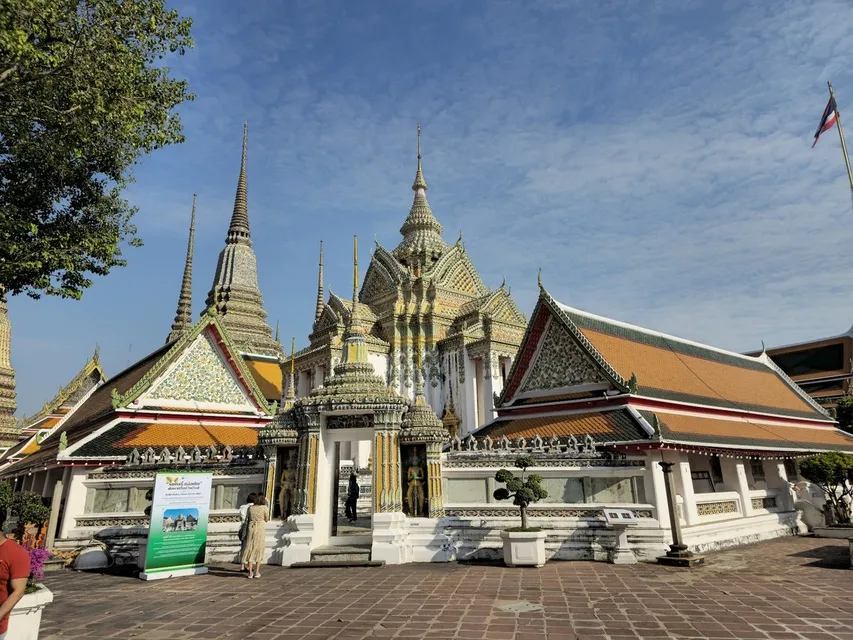
The Phra Maha Chedi Si Rajakarn are four 42-meter chedis, each in its own color of tile mosaic, for the first four kings of the Chakri dynasty: green for Rama I, white for Rama II, yellow for Rama III and dark blue for Rama IV. The Phra Ubosot, the ordination hall, was rebuilt and enlarged under Rama III, with mother-of-pearl door panels showing scenes from the Ramakien. Its principal Buddha image, Phra Buddha Theva Patimakorn, sits above a pedestal where the temple says some of King Rama I's ashes are kept.
Giants, hermits and a massage school
Stone giants guard the gates of the Phra Mondop scripture hall, and the temple tells the legend that a fight between them and the giant of Wat Arun flattened the riverbank and gave Tha Tien its name. In the rock gardens, 24 of the original 80 hermit figures still demonstrate stretching postures. That tradition continues in the Wat Po Thai Traditional Medical and Massage School, opened inside the temple in 1955, whose massage service runs through the temple's opening hours.
Visiting respectfully
Wat Pho is a working monastery. Shoes come off before you enter any religious building, visitors should never step on or climb a Buddha image, and women may not touch monks or novices. The temple asks for polite dress; its full rules are in the questions below.
Sources: Wat Pho, history, visit plan, getting there, the Reclining Buddha, architecture, massage school. Checked September 25, 2026.
Contact Information
Bangkok, 10200
Photo: Павел Антипов via Google
Wat Pho
About Wat Pho
Wat Pho, officially Wat Phra Chetuphon Wimon Mangkhalaram Rajwaramahawihan, is a first-grade royal monastery immediately south of the Grand Palace, and it is where most visitors meet Bangkok's Reclining Buddha: a gilded brick-and-stucco figure 46 meters long, its feet inlaid with mother-of-pearl. King Rama I rebuilt an older Ayutthaya-era temple here from 1788, and King Rama III's great restoration set out to make it a center of Thai arts and learning.
It pairs naturally with the Grand Palace on a first day in the old city, and it stays open well into the evening, later than its neighbor, which makes it a good second stop. Visitors who want time among the chedis and cloisters rather than a quick look at the Reclining Buddha, and anyone curious about Thai massage, will get the most from it. A ferry from Tha Tien pier crosses the river to Wat Arun.
The Reclining Buddha
The image lies in its own hall in the northwest of the temple, 15 meters high from the base to the topknot. The soles of the feet are the detail to find: mother-of-pearl panels showing the 108 auspicious symbols of the Buddha's footprint. The hall's murals, from the reign of King Rama III, tell stories of the Buddha's foremost disciples and of Buddhism in Sri Lanka.
Four royal chedis and the ordination hall
The Phra Maha Chedi Si Rajakarn are four 42-meter chedis, each in its own color of tile mosaic, for the first four kings of the Chakri dynasty: green for Rama I, white for Rama II, yellow for Rama III and dark blue for Rama IV. The Phra Ubosot, the ordination hall, was rebuilt and enlarged under Rama III, with mother-of-pearl door panels showing scenes from the Ramakien. Its principal Buddha image, Phra Buddha Theva Patimakorn, sits above a pedestal where the temple says some of King Rama I's ashes are kept.
Giants, hermits and a massage school
Stone giants guard the gates of the Phra Mondop scripture hall, and the temple tells the legend that a fight between them and the giant of Wat Arun flattened the riverbank and gave Tha Tien its name. In the rock gardens, 24 of the original 80 hermit figures still demonstrate stretching postures. That tradition continues in the Wat Po Thai Traditional Medical and Massage School, opened inside the temple in 1955, whose massage service runs through the temple's opening hours.
Visiting respectfully
Wat Pho is a working monastery. Shoes come off before you enter any religious building, visitors should never step on or climb a Buddha image, and women may not touch monks or novices. The temple asks for polite dress; its full rules are in the questions below.
Sources: Wat Pho, history, visit plan, getting there, the Reclining Buddha, architecture, massage school. Checked September 25, 2026.