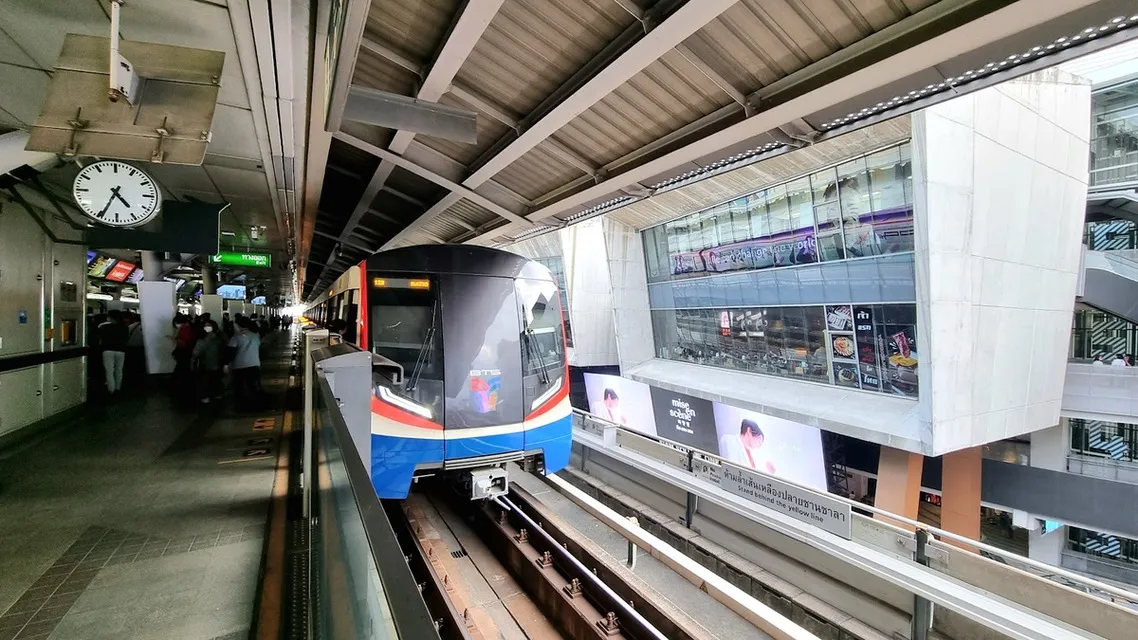
How do you get around Bangkok? For most trips, take the train: the elevated BTS SkyTrain and the MRT subway cover the central districts, skip the traffic and are easy to use without speaking Thai. Add the Chao Phraya Express Boat for the Old City and the riverside, and use metered taxis, ride-hailing apps or the occasional tuk-tuk for the gaps the rail lines leave.
This guide explains each option, when it makes sense, how to pay, and how to combine them for the trips visitors make most often.
The BTS SkyTrain
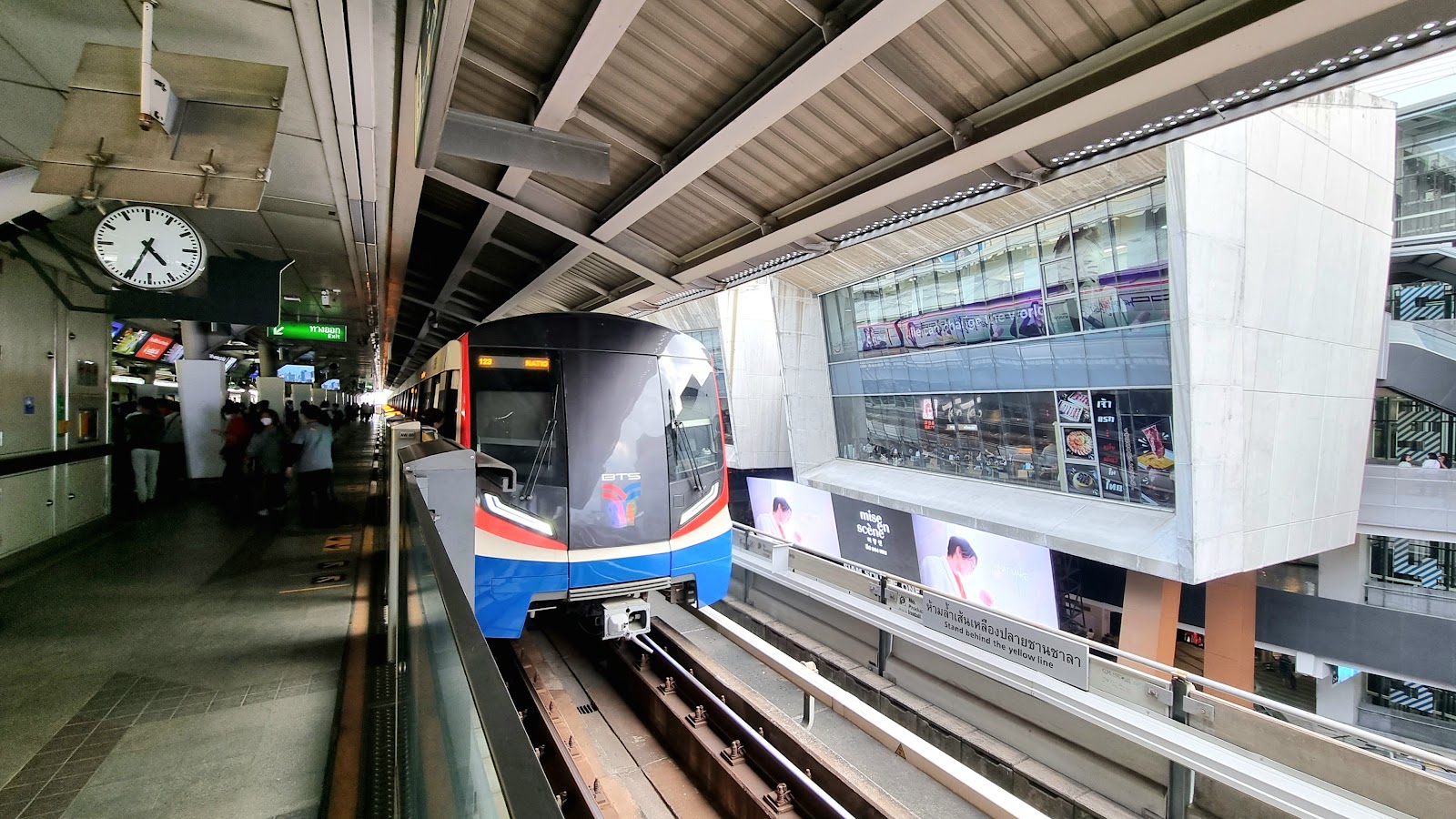
The BTS runs above the streets on two main lines that meet at Siam, in the middle of the shopping district. The Sukhumvit Line runs north to Mo Chit, next to Chatuchak, and east along Sukhumvit Road; BTS says its trains run between Mo Chit and Samrong, with further sections to Kheha in the southeast and Khu Khot in the north. The Silom Line runs from National Stadium through Silom and Sathorn and across the river towards Bang Wa. For a fuller introduction, see what the BTS is.
- Hours: BTS lists service hours of 5 a.m. to 1 a.m. Ticket offices are open 6 a.m. to midnight, and you cannot buy tickets or add value outside service hours.
- Tickets: Single Journey cards come from ticket machines, which take coins, banknotes and QR payment on the newer models. Regular riders use a stored-value Rabbit card, and a One Day Pass is sold at ticket offices. Our guide to buying a BTS ticket walks through the machines.
- Best for: Siam, Sukhumvit, Silom, Sathorn, Chatuchak and the river pier at Saphan Taksin.
The MRT subway
The MRT, run by BEM, has two lines. The Blue Line is a 48-kilometer loop with 38 stations: it runs under the city from Hua Lamphong to Bang Sue, with extensions through Chinatown to the Old City and across the river to Tha Phra and Bang Khae. The Purple Line runs between Tao Poon and Khlong Bang Phai, where its depot is.
The Blue Line is the one visitors use most, because it reaches places the BTS does not: Chinatown, and Sanam Chai station, which the Grand Palace names as its MRT stop. It meets the BTS at several stations, including Asok (MRT Sukhumvit), Sala Daeng (MRT Silom) and Mo Chit (MRT Chatuchak Park).
Paying is simple: the MRT accepts contactless Visa and Mastercard cards from domestic and international banks at the gates, as long as the card carries the contactless symbol. Tickets are also sold from vending machines at stations; see where to buy an MRT card. The BTS and MRT are separate systems with separate tickets.
The Chao Phraya Express Boat
The river is the most direct way to reach the Grand Palace, Wat Pho and Wat Arun from the rest of the city, and the boat ride itself shows you the riverside. The Chao Phraya Express Boat Company runs several flag-coded services on the river. Its website lists these routes and fares, each shown as running Monday to Friday:
- Orange flag: Nonthaburi to Wat Rajsingkorn, 18 baht flat fare.
- Yellow flag: Nonthaburi to Sathorn, 23 baht.
- Green-yellow flag: Pakkret to Sathorn, 16 to 35 baht depending on the section.
- Red flag: Nonthaburi to Sathorn, 32 baht (listed as reduced from 50 baht).
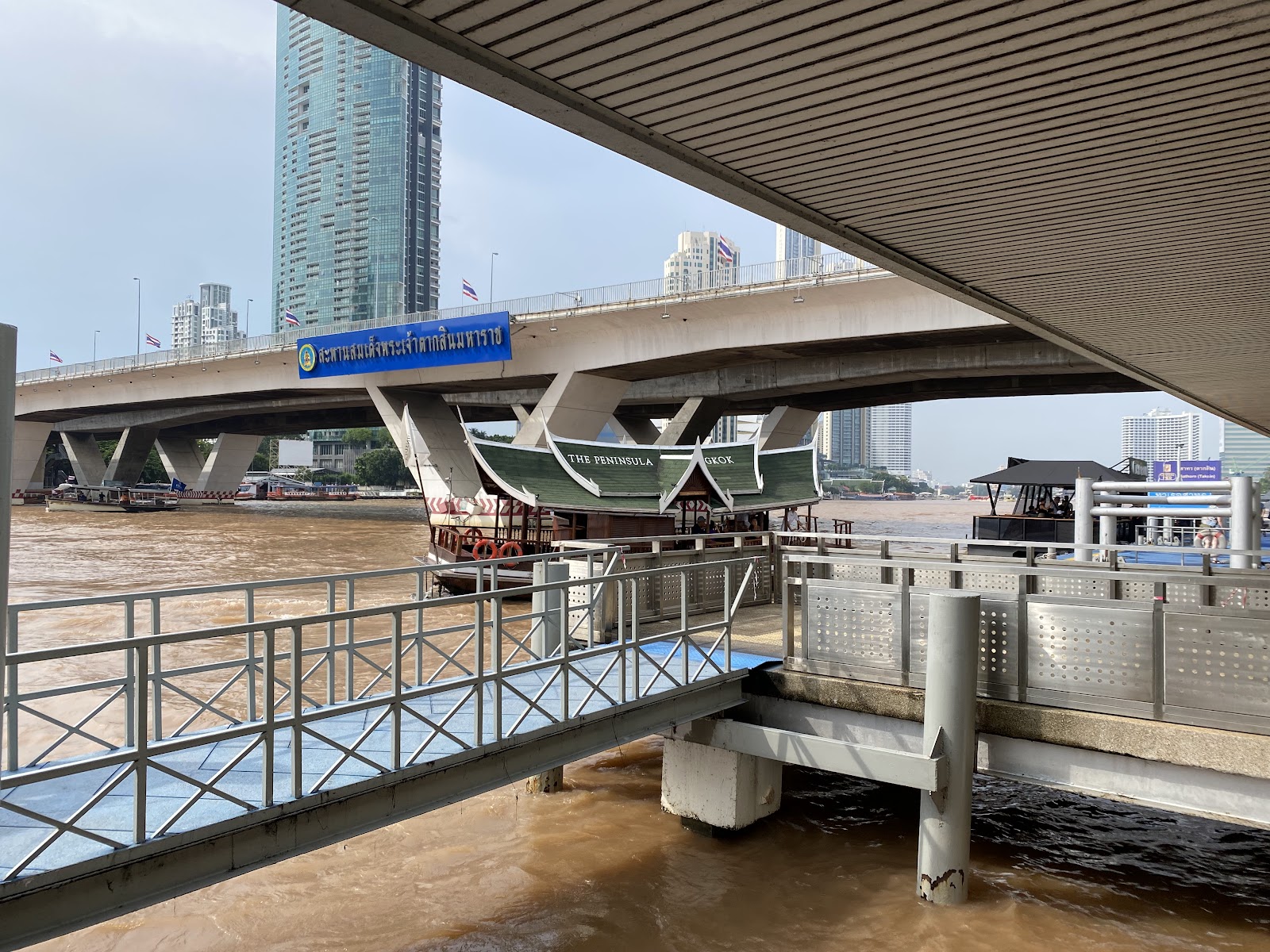
The key interchange is Sathorn Pier, under the Taksin Bridge beside BTS Saphan Taksin station. The Grand Palace's own visitor information gives the route: take the BTS to Saphan Taksin, leave by exit 2, walk to Sathorn Pier, and take the orange-flag boat to Tha Chang (N9) for the palace, or to Tha Tien (N8) for Wat Pho. Wat Arun is on the opposite bank, reached by the cross-river ferry near Tha Tien.
Not every boat stops at every pier, so check the flag color on the boat before you board and the company's current timetable before you plan a day around it.
Taxis and ride-hailing apps
Metered taxis are everywhere in central Bangkok, and ride-hailing apps such as Grab give you a price before you ride and avoid language problems with the address. Both are useful for trips the rail lines do not cover, for late nights, and when you are carrying luggage. Our guides cover how much taxis cost in Bangkok and how to use Grab.
The main drawback is traffic. At rush hour a short taxi ride across central Bangkok can take longer than the train, so if both ends of your trip are near a station, the train is usually the better choice.
Tuk-tuks
Tuk-tuks are fun for a short hop, but they have no meter, so agree the price before you get in. The Grand Palace's visitor page puts it plainly: unless you are used to bargaining, a tuk-tuk can end up costing more than a taxi, so settle the price beforehand. The UK government's travel advice also recommends taking care of bags in open vehicles such as tuk-tuks. Our guide to tuk-tuk prices has more.
Walking
Bangkok is walkable in short stretches, especially inside the Old City, around Siam and along the covered walkways that link some BTS stations to malls. Heat, busy crossings and uneven pavements make longer walks harder work than the map suggests, so plan to combine short walks with the train or boat.
Sample routes for common trips
- Sukhumvit to the Grand Palace: MRT Blue Line from Sukhumvit station to Sanam Chai, or BTS to Saphan Taksin and the orange-flag boat to Tha Chang.
- Siam to Chatuchak Weekend Market: BTS Sukhumvit Line north to Mo Chit; see our Chatuchak Weekend Market listing for details.
- Silom to Chinatown: MRT Blue Line from Silom to Wat Mangkon.
- Riverside hotel to the Old City: the boat, from the pier nearest your hotel or from Sathorn.
Getting in from the airports
Bangkok has two airports, and each has its own rail and road options into the city. Our guide to getting from Bangkok airport to the city covers Suvarnabhumi, including the Airport Rail Link, and there is a separate guide for Don Mueang.
Sources: BTS SkyTrain: service hours, BTS SkyTrain: tickets, MRT Blue Line (BEM), MRT Purple Line (BEM), MRT EMV Contactless, Chao Phraya Express Boat, The Grand Palace: practical information, UK FCDO Thailand travel advice. Checked September 26, 2026.
BTS lists service hours of 5 a.m. to 1 a.m. The last trains from Siam leave at 00:02 to all stations and at 00:15 towards Samrong, Ha Yaek Lat Phrao, Bang Wa and National Stadium. Ticket offices are open 6 a.m. to midnight.
Yes. The MRT Blue and Purple lines accept contactless Visa and Mastercard cards, including cards issued abroad, if the card shows the contactless symbol. You tap the card at the gate on entry and exit.
No. They are separate systems. The BTS uses its own Single Journey cards, One Day Pass and Rabbit card; the MRT uses its own tickets or a contactless bank card.
The company's website lists flat fares of 18 baht on the orange-flag boat (Nonthaburi to Wat Rajsingkorn), 23 baht on the yellow flag (Nonthaburi to Sathorn) and 32 baht on the red flag (Nonthaburi to Sathorn, listed as reduced from 50 baht). The green-yellow flag costs 16 to 35 baht depending on the section.
The Grand Palace suggests two rail-based routes: the MRT Blue Line to Sanam Chai, or the BTS to Saphan Taksin (exit 2), then the orange-flag boat from Sathorn Pier to Tha Chang (N9).
No. Agree the fare before you set off. The Grand Palace's visitor information warns that, without bargaining experience, a tuk-tuk can cost more than a taxi.
If both ends of your trip are near a BTS or MRT station, the train is usually faster, especially at rush hour. Taxis and ride-hailing apps are better for places far from a station, late at night and with heavy bags.