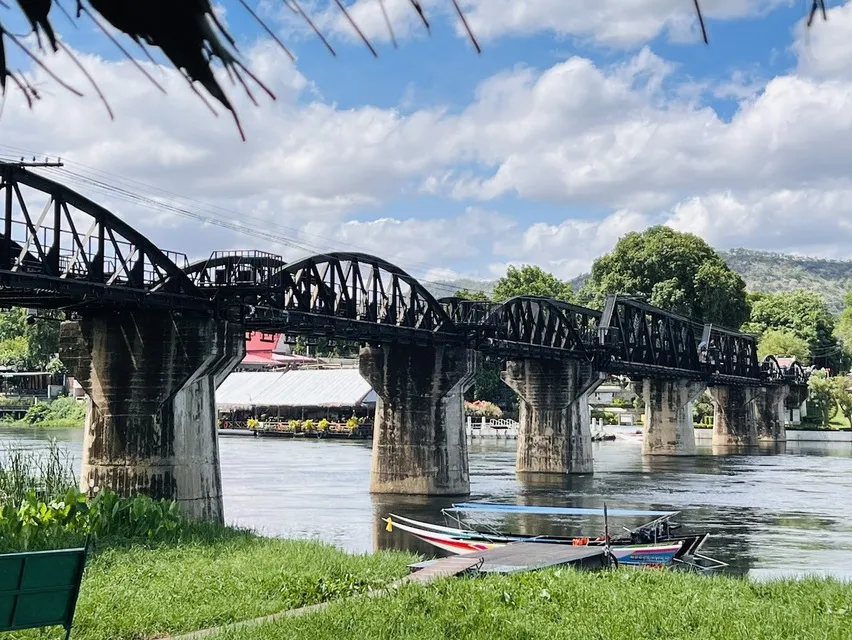
The Bridge over the River Kwai, which still carries trains on the Death Railway line Photo above: Thikhamporn2525 via Google
A Kanchanaburi day trip from Bangkok takes you to the Bridge over the River Kwai, the war cemeteries of the Death Railway and, if you start early, the waterfalls of Erawan National Park. Kanchanaburi town, in Kanchanaburi province, is 129 km north-west of Bangkok, according to the Commonwealth War Graves Commission. You can reach it by train, bus, car with driver or guided tour. One day is enough for the wartime sites, or for the bridge plus Erawan, but doing all of it well needs a car and a very early start.
The history behind the day
Most people come to Kanchanaburi because of the Burma-Siam Railway, better known as the Death Railway. The Commonwealth War Graves Commission (CWGC) describes it as a Japanese project to supply the large Japanese army in Burma, built by Commonwealth, Dutch and American prisoners of war and by Asian civilian labourers. Work began in June 1942. Two labour forces worked towards each other from Thailand and Burma, and the finished line, 424 km long, was operating by December 1943.
The cost in lives was enormous. The CWGC puts the deaths among prisoners of war at about 13,000, and estimates that 80,000 to 100,000 civilians also died, most of them forced labourers brought from Malaya and the Dutch East Indies or conscripted in Thailand and Burma. Keep both numbers in mind as you visit. The cemeteries record the prisoners by name. Far more civilians died, and most of them have no individual grave.
The Bridge over the River Kwai
The bridge carries the railway over the river at Tha Makham, in the town's home district of Mueang Kanchanaburi, and trains on the surviving line still cross it, as TAT notes in its guide to rail journeys. The name became known worldwide through the 1957 film The Bridge on the River Kwai. Every year in late November and early December, River Kwai Bridge Week stages a light-and-sound show at the bridge. TAT describes it as honoring the Allied prisoners of war and Asian labourers who built the Death Railway, the bridge and Hellfire Pass.
Kanchanaburi War Cemetery and Chungkai
The CWGC moved the graves of those who died building and maintaining the railway into three cemeteries: Kanchanaburi and Chungkai in Thailand, and Thanbyuzayat in Myanmar. American dead were repatriated.
Kanchanaburi War Cemetery is on Saeng Chuto Road, the main road through town, close to the site of the former Kanburi base camp through which most prisoners passed. The CWGC says 5,085 Commonwealth servicemen of the Second World War are buried or commemorated here, alongside 1,896 Dutch war graves. About 300 men who died at Nieke camp, most of them in a cholera epidemic in 1943, were cremated. Their ashes lie in two graves, with their names on panels in the shelter pavilion. The entrance building holds the Kanchanaburi Memorial to 11 soldiers of the army of undivided India, who are buried in Muslim cemeteries elsewhere in Thailand.
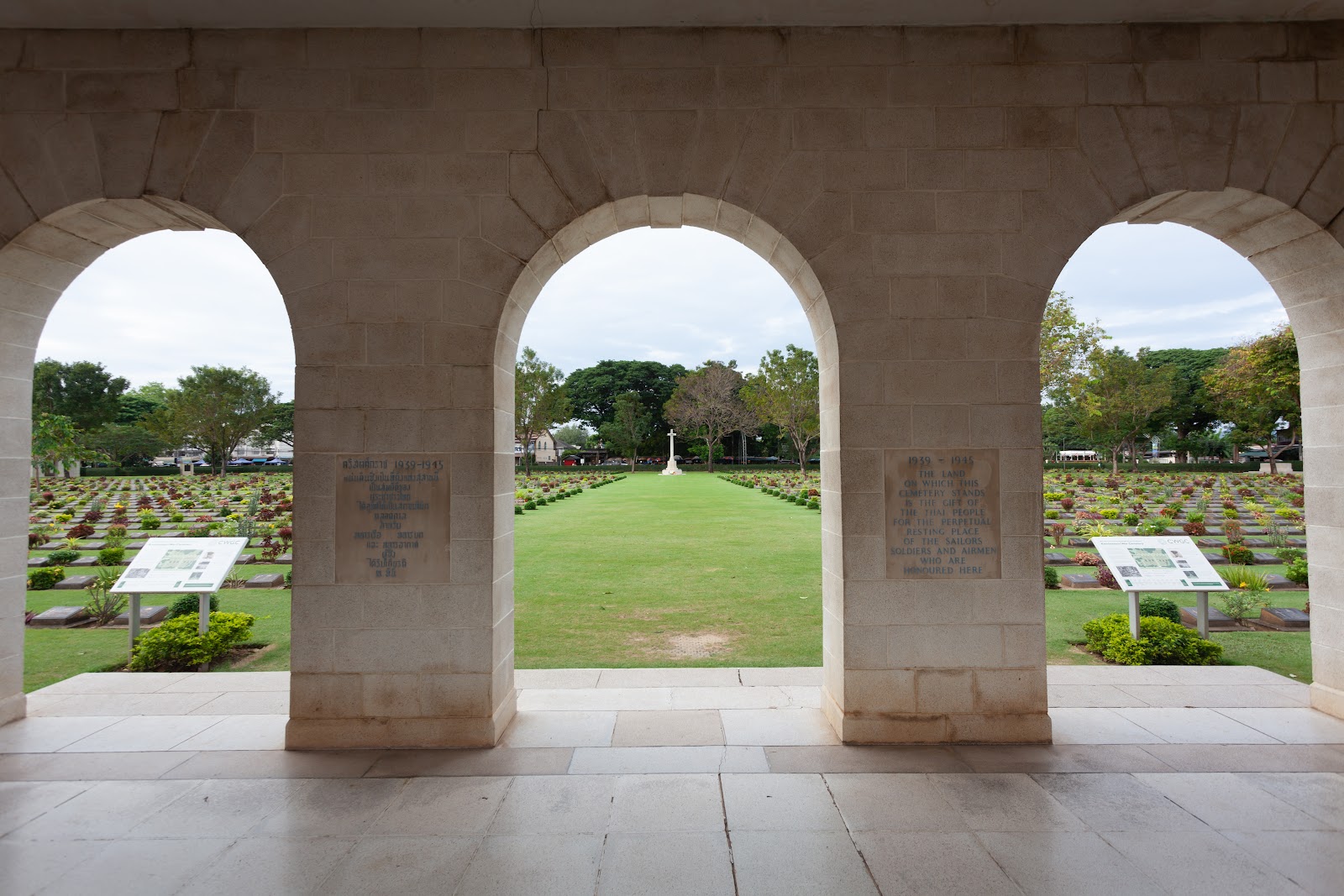
Chungkai War Cemetery is about 5 km west of town, across the river. The CWGC explains that Chungkai was a base camp with a hospital and a church built by the prisoners, and that the cemetery began as the burial ground the prisoners started themselves. Most of the 1,426 Commonwealth and 313 Dutch burials are of men who died at that hospital. It is worth the short detour if you have a car.
These are war graves. Keep your voice down, stay on the paths, and take photos with care, because some visitors come to find a relative's grave. The CWGC warns that there may be snakes in both cemeteries.
For context before or after the cemetery, the Thailand-Burma Railway Centre is a museum and research center on the western side of Kanchanaburi War Cemetery, dedicated to the history of the railway.
Riding the Death Railway by train
The State Railway of Thailand (SRT) runs the surviving section of the line. Trains leave from Thonburi station, formerly called Bangkok Noi station, on the west bank of the Chao Phraya. It is in Bangkok Noi district, about 800 meters from its original site. The old station land was handed to Siriraj Hospital, home of the Siriraj Medical Museum. The train runs through Kanchanaburi town, over the River Kwai bridge and on to Nam Tok.
TAT describes the stretch beyond Kanchanaburi as a slow trip through forest along the Khwae Noi River, and a serene way to see a sombre place. Along the way is Tham Kra Sae, a small cave in towering cliffs near the site of a former prisoner-of-war camp. TAT notes that visitors arriving by car can walk along the track there and visit the Buddha image in the cave. The train is the cheapest way to go and a meaningful one, but services are few, so the timetable shapes the whole day.
We could not reach the SRT website when we checked on September 26, 2026, and we do not print unofficial timetables. Check current trains with the SRT (railway.co.th) or the TAT Call Centre on 1672 before you plan around them. If your train leaves early, a ride-hailing car is the easiest way to reach Thonburi station; see our guide to using Grab in Bangkok.
Erawan National Park
Erawan National Park is in Kanchanaburi province, in the hills about 50 km north-west of Kanchanaburi town. TAT places it in Si Sawat district, off Highway 3199, the road towards the Srinakarin Dam. The Department of National Parks, Wildlife and Plant Conservation (DNP) manages the park, which was declared in 1975. Its main attraction is the Erawan waterfall, which falls in seven tiers named after the three-headed elephant of Hindu mythology. A trail from the visitor center climbs past the pools of the lower tiers, where many visitors swim; it is about 1.5 km from the trailhead to the top tier.
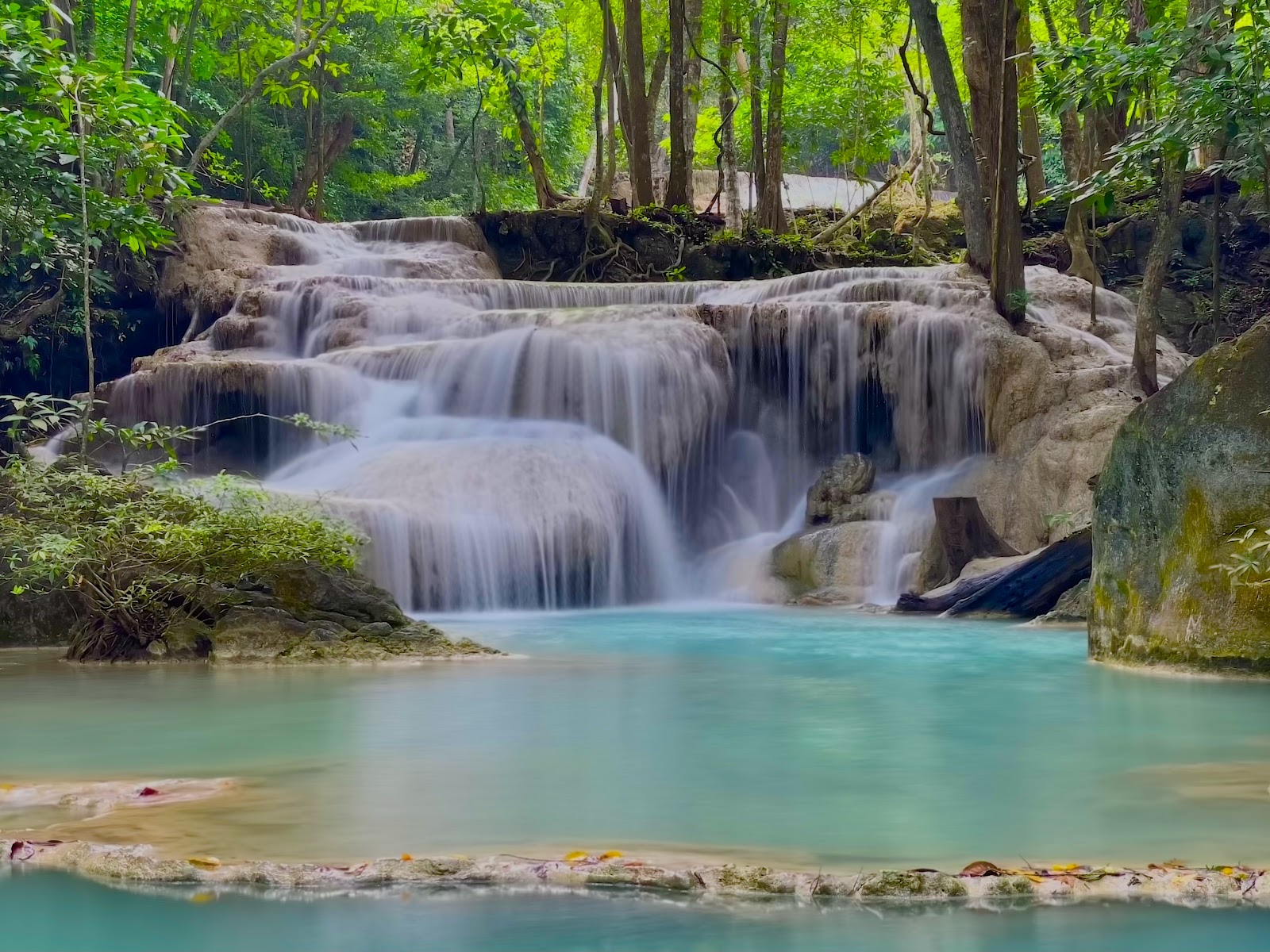
Erawan is a long way from the bridge, and no train goes there, so you need a car, a tour or local transport from town. Allow a good half day for the park alone. Wear shoes that can get wet, and treat the upper trail as a proper walk in the heat.
National park attractions in Thailand can close for part of the year, especially in the rainy season. The DNP's National Park Office publishes a list of seasonal closures by park; the version we checked on September 26, 2026, carries data dated January 7, 2026. Check it, and the park's current fees and opening hours, with the DNP before you set out. Our guide to Bangkok's rainy season explains what the monsoon months mean for travel.
Choosing your day
Seeing everything in one day is a rush. A history day (the cemetery, the museum, the bridge, then the train or Chungkai) works by train or car. A day that pairs the bridge with Erawan really needs a car with driver or a tour.
Getting there on your own
By bus
The CWGC notes that buses and trains both run from Bangkok. The Thailand-Burma Railway Centre's own directions, last updated in 2022, point to buses from Bangkok's Southern Bus Terminal on the Thonburi side. Confirm the current departure point and fare at the terminal before you go.
By car with driver
For a small group, a private car is the most flexible way to combine the cemeteries, the bridge and Erawan, and it removes the need to fit the day around the train timetable. You can book a private car charter from Bangkok to Kanchanaburi on Klook. Our guide to hiring a car with a driver in Bangkok explains how these charters work and what to agree before you set off.
Guided tours from Bangkok
A tour handles the long drive and usually adds a guide, which helps at sites where the history matters more than what you see. Two options on Klook:
- The Kanchanaburi highlights day tour, built around the main wartime sites.
- A tour that pairs the River Kwai Bridge with a Kanchanaburi safari park, a privately run wildlife park. It spends less time on the railway's history, so choose it only if the park interests you.
Before you book, check the pickup point, what entrance fees are included, whether lunch is provided, and which sites are on the route.
Practical notes
- Heat. The cemeteries and the bridge have little shade. Bring water, a hat and sunscreen.
- Dress. Dress modestly out of respect at the cemeteries and memorials, and bring swimwear only if Erawan is on your plan.
- Staying over. TAT suggests spending the night in Kanchanaburi if you want to see the museums and ride the railway without rushing.
For more to see once you are back in the city, browse our Bangkok attractions guide.
BangkokVacay may earn a commission from Klook bookings made through links in this article, at no extra cost to you.
Sources: Commonwealth War Graves Commission, Kanchanaburi War Cemetery, Commonwealth War Graves Commission, Chungkai War Cemetery, TAT Newsroom, Training in Thailand (2019), TAT Newsroom, Kanchanaburi feature (2018), TAT Newsroom, River Kwai Bridge Week (2022), TAT Newsroom, national park seasonal closures (2026), DNP National Park Office, seasonal closure list (data of January 7, 2026), Department of National Parks, Wildlife and Plant Conservation, Thailand-Burma Railway Centre, visitor information, Wikipedia, Erawan National Park, Wikipedia, Thon Buri railway station. Checked September 26, 2026.
Kanchanaburi town is 129 km north-west of Bangkok, according to the Commonwealth War Graves Commission. It is the capital of Kanchanaburi province.
Yes. A day is enough for the war cemetery, the railway museum and the River Kwai bridge, or for the bridge plus Erawan National Park if you go by car with driver or on a tour. Start early.
Thonburi station, formerly called Bangkok Noi station, on the west bank of the river. The State Railway of Thailand line runs through Kanchanaburi and over the River Kwai bridge to Nam Tok. Check current times with the SRT or the TAT Call Centre on 1672.
The Commonwealth War Graves Commission lists 8 a.m. to 5 p.m. Monday to Friday and 8 a.m. to noon on Saturday. It lists Chungkai War Cemetery as permanently open. Both pages were checked on September 26, 2026.
The CWGC records 5,085 Commonwealth casualties of the Second World War buried or commemorated there, plus 1,896 Dutch war graves.
About 50 km north-west of town, in Si Sawat district. There is no train, so go by car with driver, on a tour or by local transport.
Check the current fee with the Department of National Parks, Wildlife and Plant Conservation before you go. We could not verify a current rate from the DNP on September 26, 2026.
Every year in late November and early December, with a light-and-sound show at the bridge, according to TAT. Check the current year's dates with the TAT Kanchanaburi office.