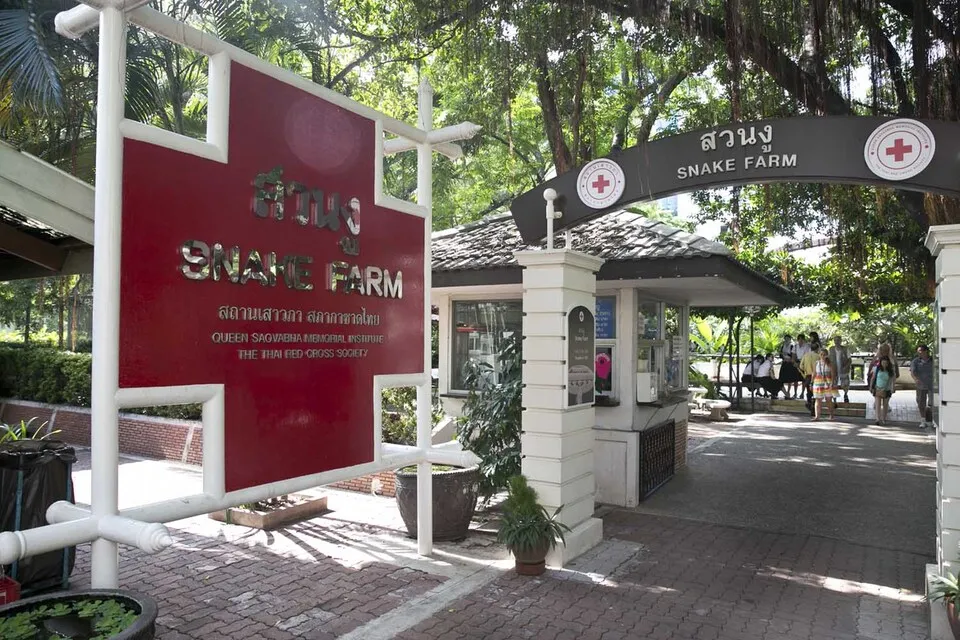
Snake Farm, Queen Saovabha Memorial Institute
About
The Snake Farm at Queen Saovabha Memorial Institute is part of a working institute of the Thai Red Cross Society, which produces antivenom and distributes much of the country's vaccines and serums. The snakes kept here are part of that work: the farm breeds venomous species and studies their venom, and visitors can watch staff extract venom and handle snakes in scheduled demonstrations.
It suits curious families, science-minded travelers and anyone who wants to understand Thailand's venomous snakes rather than simply look at them. The institute stands on Rama IV Road near King Chulalongkorn Memorial Hospital, and the stations it recommends are BTS Sala Daeng and MRT Sam Yan. Timing matters, because the demonstrations run at fixed hours and the farm closes early at weekends.
What you see
On weekdays there is a venom extraction demonstration in the late morning and a snake handling demonstration in the afternoon; at weekends and on public holidays there is one handling demonstration in the late morning. The institute's snake guide covers the species of public-health importance in Thailand, starting with the king cobra and the Siamese cobra, which helps put the demonstrations in context.
Behind the demonstrations
The farm has bred snakes since April 1994, concentrating on the king cobra, which eats other snakes. Its staff study venom strength, enzymes and composition and work with the institute's serum production and research departments, and the aim of the husbandry, in the farm's own words, is healthy snakes and good-quality venom for making antivenom.
A royal memorial
The institute grew out of the Pasteur Institute, founded in 1913 after a daughter of Prince Damrong Rajanubhab died of rabies. After the cremation of Queen Saovabha Phongsri in 1920, King Vajiravudh gave land at the corner of Rama IV Road and funds from his private purse for a new building in her memory, and he opened Queen Saovabha Memorial Institute on 7 December 1922. The main building, in a European style adapted to the hot climate, is now a conserved building.
Clinics on the same site
The institute also runs a travel medicine and immunization clinic, a rabies prevention clinic and an animal toxin clinic for walk-in patients, useful for travelers who need vaccines in Bangkok. The clinics accept cash in Thai baht only. The institute no longer treats snakebite as an inpatient service and advises anyone bitten to go to the nearest hospital.
Sources: Thai Red Cross Society: Queen Saovabha Memorial Institute, institute FAQ (archived May 2026), contact (archived June 2026), snake farm research (archived June 2026), institute history (archived June 2026). Checked September 26, 2026.
Contact Information
Bangkok, 10330
Photo: Jim Heston via Google
Snake Farm, Queen Saovabha Memorial Institute
About Snake Farm, Queen Saovabha Memorial Institute
The Snake Farm at Queen Saovabha Memorial Institute is part of a working institute of the Thai Red Cross Society, which produces antivenom and distributes much of the country's vaccines and serums. The snakes kept here are part of that work: the farm breeds venomous species and studies their venom, and visitors can watch staff extract venom and handle snakes in scheduled demonstrations.
It suits curious families, science-minded travelers and anyone who wants to understand Thailand's venomous snakes rather than simply look at them. The institute stands on Rama IV Road near King Chulalongkorn Memorial Hospital, and the stations it recommends are BTS Sala Daeng and MRT Sam Yan. Timing matters, because the demonstrations run at fixed hours and the farm closes early at weekends.
What you see
On weekdays there is a venom extraction demonstration in the late morning and a snake handling demonstration in the afternoon; at weekends and on public holidays there is one handling demonstration in the late morning. The institute's snake guide covers the species of public-health importance in Thailand, starting with the king cobra and the Siamese cobra, which helps put the demonstrations in context.
Behind the demonstrations
The farm has bred snakes since April 1994, concentrating on the king cobra, which eats other snakes. Its staff study venom strength, enzymes and composition and work with the institute's serum production and research departments, and the aim of the husbandry, in the farm's own words, is healthy snakes and good-quality venom for making antivenom.
A royal memorial
The institute grew out of the Pasteur Institute, founded in 1913 after a daughter of Prince Damrong Rajanubhab died of rabies. After the cremation of Queen Saovabha Phongsri in 1920, King Vajiravudh gave land at the corner of Rama IV Road and funds from his private purse for a new building in her memory, and he opened Queen Saovabha Memorial Institute on 7 December 1922. The main building, in a European style adapted to the hot climate, is now a conserved building.
Clinics on the same site
The institute also runs a travel medicine and immunization clinic, a rabies prevention clinic and an animal toxin clinic for walk-in patients, useful for travelers who need vaccines in Bangkok. The clinics accept cash in Thai baht only. The institute no longer treats snakebite as an inpatient service and advises anyone bitten to go to the nearest hospital.
Sources: Thai Red Cross Society: Queen Saovabha Memorial Institute, institute FAQ (archived May 2026), contact (archived June 2026), snake farm research (archived June 2026), institute history (archived June 2026). Checked September 26, 2026.
Frequently Asked Questions
Things to do in Bangkok
BangkokVacay may earn a commission from Klook bookings made through this box, at no extra cost to you.